The Science of the Pocket Rod: A Deep Dive into Ultralight Travel Fishing Gear
Update on Aug. 1, 2025, 4:55 p.m.
The call of the wild often leads us to places where a standard, two-piece fishing rod is simply impractical. A towering mountain lake, a secluded river at the end of a long hiking trail, or a hidden stream discovered while road-tripping—these are the moments that demand a different kind of gear. This is the domain of the ultralight travel rod, a marvel of engineering designed to bridge the gap between performance and portability.
The central challenge in creating a travel rod is overcoming a fundamental law of physics: a longer lever provides more power, but is harder to transport. For centuries, anglers solved this with multi-section rods that could be broken down and packed away. But what if we could take that concept a step further, and collapse an entire rod into a footprint small enough to fit in a backpack or even a suitcase? This is the promise of the telescopic fishing rod.
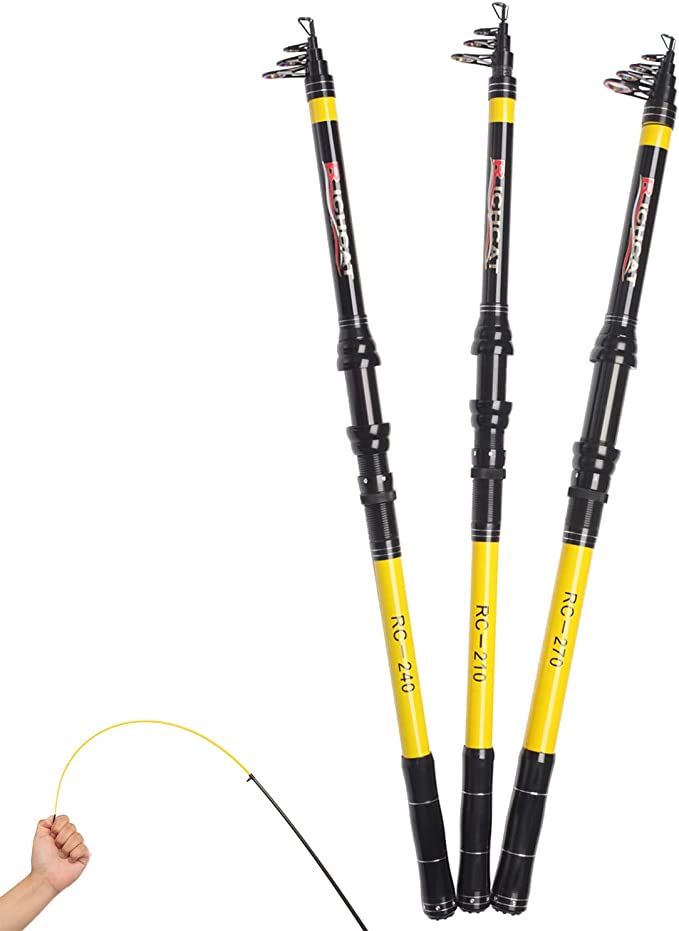
The mechanics behind a well-designed telescopic rod are a testament to clever engineering. The sections are not simply “stuck together”; they are precisely tapered to fit snugly within one another. When extended, these ferrule joints create a continuous action throughout the blank, mimicking the feel of a traditional one-piece rod. This design allows a 6-foot rod to collapse to just over a foot, a transformation that turns a logistical problem into a non-issue. The ability to carry a functional rod with such a minimal profile is the very essence of packability and the core reason for its existence.
At the heart of the modern travel rod lies a revolution in material science: carbon fiber. The RICHCAT rod, for example, is constructed from 100% carbon fiber, a material prized for its incredible strength-to-weight ratio. This is not a marketing term; it’s a fundamental property of the material. Carbon fiber is made of thousands of tiny carbon filaments woven together and set in a polymer resin. By manipulating the angle of the weave and the grade of the fiber (its modulus), engineers can create a fishing rod blank that is incredibly light, yet remarkably strong. This not only reduces the overall weight of the gear—a critical factor for ultralight backpackers—but also allows for exceptional bite sensitivity. The blank acts like a fine-tuned instrument, transferring the smallest vibrations from a fish’s take directly to the angler’s hand.
This focus on sensitivity is directly tied to the rod’s action. A “fast action” rod, as this one is described, means that it bends primarily in the top third of the blank. This design choice provides two key benefits: it allows for quick, powerful hook sets and offers the fine tip control needed to cast lighter lures with precision. This makes it an ideal choice for freshwater fishing scenarios, whether you are targeting bass and trout in a mountain lake or smaller panfish in a quiet river.
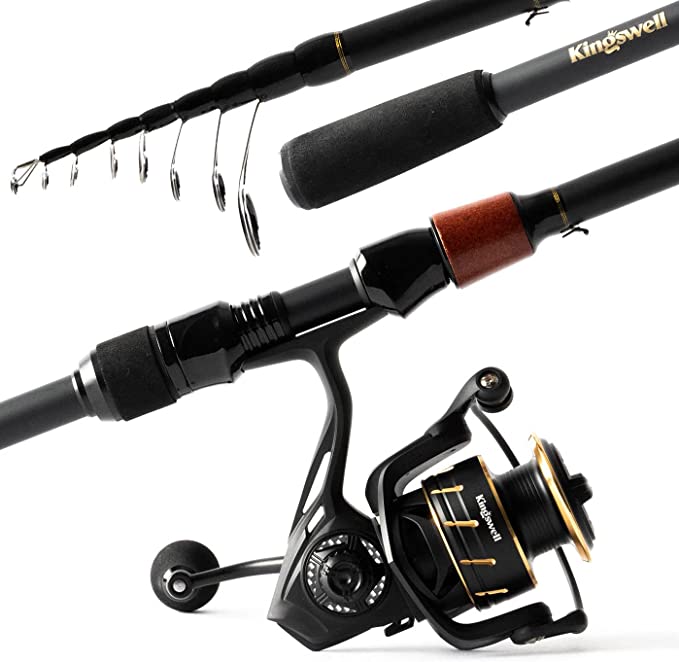
Of course, a great rod is more than just its blank. High-quality components are essential for a reliable experience. The lightweight graphite spinning reel seat with its double-lock mechanism ensures your reel remains secure, a minor but crucial detail when battling a feisty fish. The ceramic guides, which are a universal standard in modern rods, are particularly important. Their smooth, polished surface minimizes friction on the fishing line, allowing for longer, more accurate casts and preventing heat buildup, especially when using durable braided or fluorocarbon lines.
The ultimate test for any piece of gear, however, is its performance in the field. User feedback, though limited, offers a glimpse into the reality of these products. An angler packing this rod on a long hike to an alpine lake and successfully landing a native cutthroat trout is a powerful testament to the rod’s intended purpose. It’s a story that encapsulates the very spirit of travel fishing. Yet, it is equally important to acknowledge the trade-offs. The report of a tip guide falling off on the first outing highlights a potential point of weakness common to mass-produced gear. It’s a reminder that while the engineering principles are sound, the execution and quality control can vary.
Ultimately, an ultralight telescopic rod like the RICHCAT is more than just a tool. It’s a key that unlocks new possibilities, transforming a long hike or a distant camping trip into a complete outdoor experience. It represents a design philosophy where convenience does not come at the expense of a genuine fishing adventure. The technology behind it—the carbon fiber, the fast action, the telescopic design—all serve one purpose: to ensure that wherever your travels take you, a great day on the water is always within reach.