The Physics of the "Quiet" Conductor: Understanding the Limitations of Passive Bone Conduction
Update on Jan. 15, 2026, 1:35 p.m.
A common complaint among users of wired bone conduction headphones like the GZCRDZ C630 is volume: “It’s too quiet.” This is not necessarily a defect; it is a matter of physics. Specifically, it is a challenge of Power Transfer Efficiency in a passive system.
Unlike their wireless cousins, which have built-in amplifiers powered by batteries, the C630 relies entirely on the tiny voltage provided by the phone or radio’s headphone jack. This article explores the Electro-Mechanical Physics of driving bone conduction transducers passively, the issue of Sound Leakage, and why understanding these limitations is key to proper use.
The Energy Deficit: Driving a Skull with Milliwatts
A standard headphone driver moves air, which is light. A bone conduction transducer must vibrate the skull, which is heavy and dense. This requires significantly more energy. * Impedance Matching: The output of a standard phone jack is designed to drive sensitive dynamic drivers (moving coils). It often lacks the current swing needed to forcefully vibrate the piezoelectric or heavy-mass electromechanical transducers used in bone conduction. * The Result: The vibration amplitude is lower. The sound reaching the inner ear is fainter.
This is why many users find the C630 “quiet.” It is a physical mismatch between the source power and the mechanical load. To overcome this, users often need an external Headphone Amplifier, or they must use the device in quieter environments.
The “Fake” Bone Conduction Debate: Sound Leakage
Another frequent criticism is that the device acts like “little speakers on the cheekbones” rather than true bone conduction.
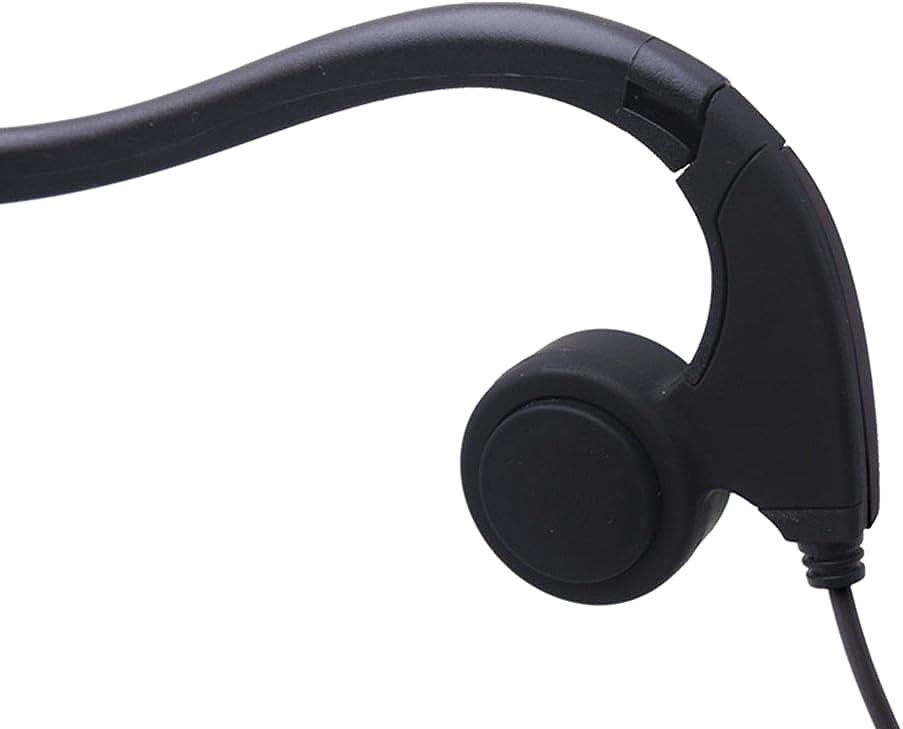
In reality, All Bone Conduction Leaks Sound. The transducer housing vibrates. This vibration couples with the air, creating audible sound waves. In a passive system like the C630, if the clamping force is loose, the transducer may bounce against the skin rather than coupling tightly with the bone.
* Loose Fit: Creates more air conduction (leakage) and less bone conduction.
* Tight Fit: Maximizes bone conduction transfer but can cause physical discomfort.
The C630’s generic plastic headband may struggle to provide the optimized clamping force of higher-end titanium models, leading to a mix of air and bone conduction that confuses users. However, the mechanism—vibrating the head—is still fundamentally present.
The Physics of Isolation: Why Earplugs Increase Volume
There is a counter-intuitive hack for bone conduction: Wear Earplugs.
When you block your ear canal with foam plugs, you eliminate the masking effect of ambient noise. More importantly, you create the Occlusion Effect.
* Physics: The closed ear canal traps the low-frequency vibrations radiating from the skull cartilage. This amplifies the bass and volume of the bone-conducted sound significantly.
For industrial workers or those mowing the lawn, wearing the C630 over standard earplugs allows them to hear music clearly while protecting their hearing from the machinery noise. This is a primary use case where the “quiet” C630 suddenly becomes loud enough.
Conclusion: Managing Expectations
The GZCRDZ C630 is a study in compromise. By removing the battery, it gains reliability but loses power. By lowering the cost, it sacrifices the sophisticated suspension systems that minimize leakage.
Understanding these physical constraints transforms the user experience. It is not a broken device; it is a passive device operating at the limits of physics. Used correctly—in quiet rooms or paired with earplugs—it offers a unique auditory utility that no standard earbud can match.