Engineering for the Elements: Durability, Hygiene, and the Limits of Bone Conduction
Update on Jan. 15, 2026, 11:48 a.m.
A piece of sports equipment is only as good as its weakest link. For headphones, that link is often moisture. Sweat is not just water; it is a corrosive cocktail of salts, oils, and acids. To survive on the head of a runner or cyclist, a device must be more than just “water-resistant”; it must be biologically hardened.
The CelsusSound S800C tackles this with an IPX7 rating and a Titanium Alloy structure. But beyond durability, users must also understand the physics of Sound Leakage and Bass Response—the inherent trade-offs of open-ear technology. This article explores the engineering of waterproofing, the hygiene of open designs, and the acoustic boundaries of vibrating bone.
The Chemistry of Sweat Proofing: IPX7 Explained
The S800C is rated IPX7. As discussed in other contexts, this means it can survive immersion. But for a runner, the threat isn’t a swimming pool; it’s the slow, insidious accumulation of sweat. * Corrosion Resistance: The “Magnetic Charging Port” is a key feature here. Traditional USB ports have cavities where sweat can pool, leading to galvanic corrosion of the contacts. Magnetic pogo-pins are flat and easy to wipe clean, removing the electrolyte (sweat) before it eats the metal. * Hydrophobic Coatings: The device likely employs a nano-coating or a sealed silicone skin (“Easy to Clean”). This creates a surface with low surface energy, causing sweat beads to roll off rather than stick. This is critical for preventing salt buildup, which can block microphones or degrade buttons over time.
The Hygiene Advantage: Otitis Externa Prevention
One of the most overlooked benefits of bone conduction is Hygiene. * The Greenhouse Effect: In-ear earbuds trap heat and moisture in the ear canal. This creates a perfect incubator for bacteria and fungi, leading to Otitis Externa (Swimmer’s Ear). * Airflow: By leaving the ear canal open, the S800C maintains natural ventilation. The skin of the ear canal remains dry and the pH balance is preserved. For daily runners or those prone to ear infections, this is a medical advantage, not just a comfort feature.
The Physics of Trade-offs: Leakage and Bass
Bone conduction is not magic; it is physics, and physics has rules.
* Sound Leakage: To vibrate the skull, the transducer must vibrate violently. This vibration inevitably couples with the surrounding air, creating audible sound waves. This is “leakage.”
* The Fix: Modern devices use Phase Cancellation techniques (similar to ANC) to emit an inverted wave from the housing to cancel out the leaked sound. While not perfect, it minimizes what the person sitting next to you hears.
* Bass Response: Bass requires moving a lot of mass. It is easy to move air (light); it is hard to move a skull (heavy). Bone conduction struggles to reproduce sub-bass frequencies because the skull has high Mechanical Impedance at low frequencies. The sensation of bass in bone conduction is often more “tactile” (tickling) than auditory. Understanding this limitation manages expectations: these are for cadence and vocals, not for sub-bass immersion.
Structural Engineering: The Titanium Memory
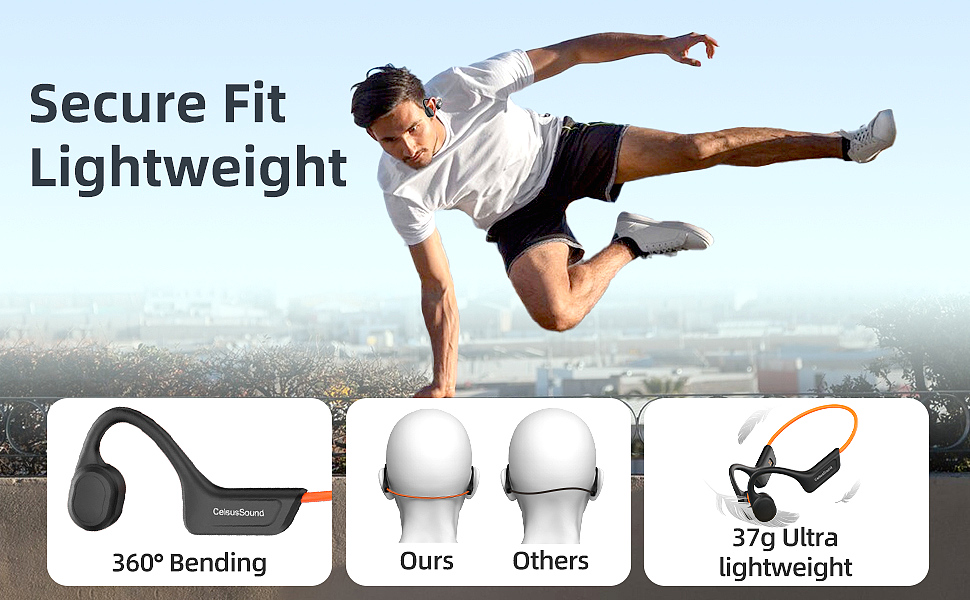
The S800C weighs just 36g and uses a Titanium Alloy band.
* Elastic Deformation: Titanium has a high yield strength. You can bend the band flat, and it springs back to its original curve. This ensures that the Clamping Force remains constant over years of use.
* The Goldilocks Clamp: The force must be strong enough to press the transducers firmly against the bone for efficient sound transfer, but light enough not to cause headaches. Titanium’s memory allows engineers to dial in this force precisely.

Conclusion: The Rational Choice for Activity
The CelsusSound S800C is a device defined by its context. In a quiet room, traditional headphones sound better. But on a rainy trail, a busy street, or a sweaty gym floor, the S800C is superior.
By engineering for IPX7 Durability, prioritizing Ear Hygiene, and utilizing Titanium for secure comfort, it solves the specific physical problems of the athlete. It accepts the acoustic limitations of bone conduction in exchange for the priceless utility of safety and reliability.