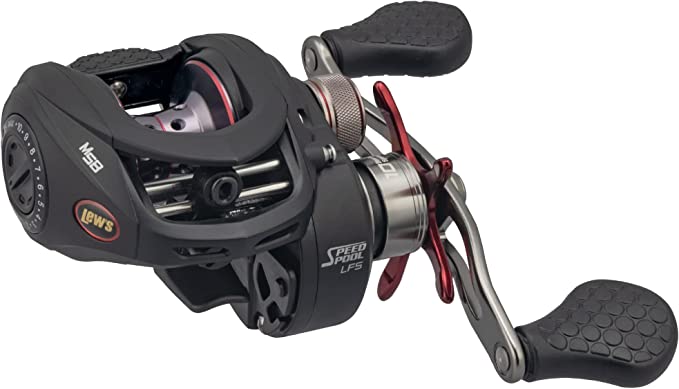
The Kinetics of Casting: Engineering the Lew's Tournament MP
Update on Feb. 10, 2026, 2:02 p.m.
In the world of angling, the baitcast reel is a paradox: it is capable of extreme precision yet prone to chaotic failure. The “bird’s nest”—a tangled snarl of line—is not merely an annoyance; it is a manifestation of unmanaged inertia. When the spool rotates faster than the lure pulls the line, physics takes over, and the line overruns.
Mastering this chaos requires more than a thumb; it requires engineering. The Lew’s Tournament MP Speed Spool is a case study in managing angular momentum and friction. By analyzing its dual-braking system and pinion geometry, we can understand how mechanical design tames the violent physics of a cast.
Dual-Stage Braking: Lenz’s Law meets Centrifugal Force
A cast has two distinct phases: the high-velocity startup and the deceleration phase as the lure loses momentum to air resistance. A single braking system struggles to manage both. The Tournament MP utilizes a Multi-Setting Brake (MSB) system that combines two distinct physical principles.
1. The Startup: Centrifugal Force
At the beginning of a cast, the spool accelerates rapidly, reaching thousands of revolutions per minute. Here, the reel deploys Centrifugal Braking. Four internal brake shoes are mounted on the spool assembly. As the spool spins, centrifugal force ($F = mr\omega^2$) pushes these shoes outward against a friction ring. Since the force increases with the square of the speed, the braking is most aggressive exactly when it is needed most: at peak RPM. This prevents the initial overrun.
2. The Deceleration: Magnetic Induction
As the lure slows down, centrifugal force diminishes. If left unchecked, the spool would still spin too freely. This is where Magnetic Braking takes over. This system relies on Lenz’s Law. The spool passes through a magnetic field created by external magnets. This induces eddy currents in the aluminum spool. These currents create their own magnetic field that opposes the original field, creating a drag force that is proportional to the speed of rotation. It provides a smooth, non-contact resistance that “feathers” the spool speed down to zero, ensuring the line stays tight as the lure lands.
The Geometry of Gear Alignment: P2 Super Pinion
Inside a reel, the pinion gear is the critical interface between the handle’s input and the spool’s rotation. In standard designs, the pinion gear is often supported only at the ends, leaving the meshing teeth vulnerable to deflection under load. When a user cranks hard against a heavy fish, the gears can slightly separate, leading to increased wear and a “gritty” feel.
Lew’s addresses this with the P2 Super Pinion architecture. This design introduces a dedicated bearing support system specifically for the pinion gear. From a mechanical engineering standpoint, this converts the gear from a cantilevered beam (supported on one end) to a simply supported beam (supported on both sides). * Load Distribution: The bearing absorbs the radial loads, keeping the pinion perfectly aligned with the main drive gear. * Mesh Efficiency: By maintaining precise contact geometry between the gear teeth, friction is minimized, and power transfer efficiency is maximized. This is what creates the sensation of “smoothness”—it is the absence of mechanical inefficiency.
Structural Mechanics: The Aluminum Chassis
Rigidity is the unsung hero of reel performance. While graphite and composites are light, they possess a lower Young’s Modulus (stiffness) compared to metal. Under the high torque of retrieving a deep-diving crankbait or fighting a bass in heavy cover, a composite frame can flex.
This flexing causes misalignment of the internal components. Bearings shift, shafts angle, and gears grind. The Tournament MP uses a one-piece aluminum frame. Aluminum alloys offer a high strength-to-weight ratio and, crucially, high stiffness. This metal chassis acts as a rigid exoskeleton, ensuring that the precise tolerances engineered into the P2 Super Pinion and the 10-bearing system remain true, regardless of the load applied to the reel.
Tribology of the Drag System
The final line of defense is the drag system—essentially a clutch designed to slip at a specific torque threshold. The goal is to maintain a constant coefficient of friction ($\mu$) even as heat builds up.
The Tournament MP employs a Carbon Fiber Drag system rated for 20 pounds. In tribology (the study of friction and wear), carbon fiber is superior to traditional felt or cork washers because of its thermal stability. * Static vs. Dynamic Friction: Poor drag systems have high “start-up” inertia (stiction), meaning it takes more force to start the line moving than to keep it moving. This jerkiness breaks lines. Carbon fiber exhibits a very low difference between static and dynamic friction, ensuring the line releases smoothly the instant the fish surges. * Heat Dissipation: Friction generates heat. Carbon fiber conducts heat efficiently and resists glazing or melting, ensuring consistent performance during long, high-tension fights.
Conclusion
The Lew’s Tournament MP Speed Spool is not just a fishing reel; it is a precision instrument designed to manipulate the laws of motion. By integrating the quadratic response of centrifugal brakes with the linear control of magnetic induction, and supporting it all with a rigid aluminum skeleton, it solves the complex physical problems of casting and retrieving. It demonstrates that in the battle between angler and fish, the most important ally is good engineering.